
March 26, 2015
Ancient court music, Buddhist chants, Japanese dancing and music - The charm of traditional performing arts
Mikio Ishibashi, National Theatre
We've touched upon many stage arts in the Welcome to the Theatre section of Bunkaru, but for this post, I would like to introduce four more traditional arts that we have not yet covered: ancient court music, Buddhist chants, Japanese dancing, and music.
Ancient court music (gagaku)
This is an art form that combines various other arts including ancient Japanese music and dance, as well as those transmitted from continental Asia. This art form has the longest history in Japan. The performance includes music (kangen) using ancient instruments, a dance that accompanies the music (bugaku), and a song that is sung to the music (kayou). It is performed at annual events in Court, temples, and shrines. The dancing portions that accompany some of the tunes have been lost in the transmission, but for the surviving dance and song combinations, you will notice an interesting difference in the rhythm and melody for the same song with and without the accompanying dance.
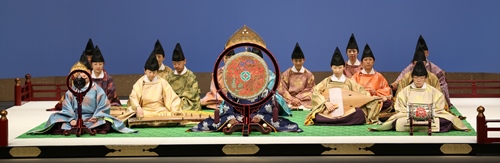
A kangen performance: reigakusha
Buddhist chant (shomyo)
Shomyo refers to the melodic chanting of Buddhist monks with topics that include memorial services for one's ancestors, wishing for a peaceful country, and showing gratitude for the Buddha. It is said to be transmitted along with Buddhism, and through time the chanting became more melodic. Just as the Buddhist customs differ by sect, so does the chanting as it takes on different characteristics. For example, the same sutra chant can be heard in different ways depending on whether the sect is Tendai, Shingon, or Jodo.
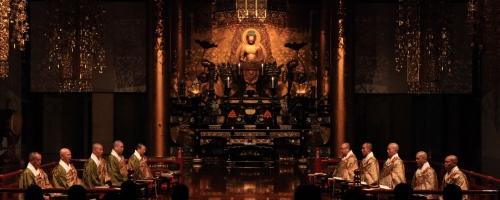
A buddhist memorial service in the Jodo sect
Japanese dancing
This performance art is developed from kabuki. Like ballet, there is beauty and charm in the expressivity of the repeated rhythmic, active movements. In Japanese dancing, there are lyrics that accompany some of the music, and the movements are physical manifestations of those lyrics. Sometimes, the dancing is performed with specific roles such as warriors, a prostitute or a town girl. By adding words to the music, the expressive capacity of the dance increases. For example, the moon or mountains can be expressed through physical movements and clothing, or through the use of small tools.
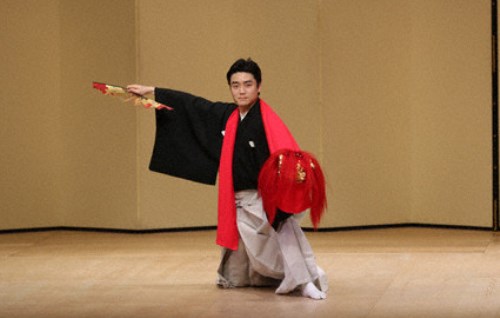
Onoe Kikunojo: Renjishi
Traditional Japanese music (hougaku)
Traditional music includes long, epic songs, the gidayuu ballad drama, music played using the koto, and music played using a Japanese lute called the biwa. These musical forms developed as they influenced a variety of other performance arts. Just as there are different genres of music, there are different characteristics of the music depending on the voice and instrument used. For example, the biwa sounds heroic, while the koto is more graceful. You can enjoy a greater depth of music just by comparing the characteristics of the songs and their stories.
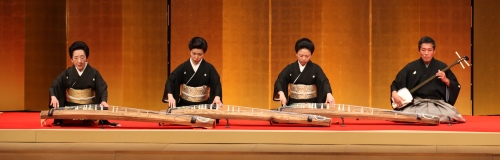
From left: Shouin Yamase, Maiko Yamase, Mitsuse Okuyama, and Showa Yamato.
"Kotobuki kurabe"
The program "The Charm of Traditional Performing Arts" will open in June at the National Theatre (Small Theatre). It is a good opportunity to enjoy the four traditional arts showcased above, and we look forward to seeing you there!